




Why Has the US Federal Reserve Not Raised Interest Rates Despite Rising Inflation?
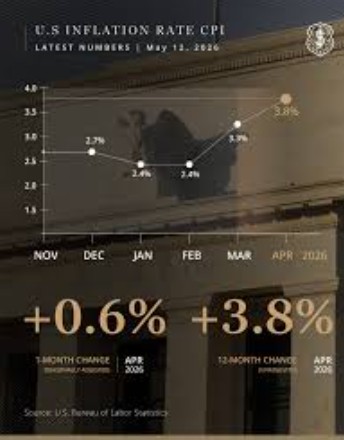
Over recent months, investors have become increasingly puzzled by one question: if inflation in the United States is rising again, why has the US Federal Reserve (Fed) not lifted interest rates further?
The answer lies in the complex balancing act currently facing policymakers.
While inflation pressures have clearly re-emerged - particularly due to higher oil and energy prices linked to the ongoing conflict involving Iran - the Fed remains cautious about tightening policy too aggressively. Energy driven inflation is very different from broad-based demand inflation. The Fed understands that raising rates cannot directly lower oil prices or resolve geopolitical conflict.
At present, the Fed is attempting to avoid making a policy mistake that could unnecessarily slow economic growth. Higher interest rates would increase borrowing costs for households and businesses at a time when parts of the US economy are already showing signs of moderation, particularly in consumer spending and housing activity.
Importantly, the Fed also recognises that much of the current inflation pressure may prove temporary if geopolitical tensions ease and energy markets stabilise. Minutes from recent Federal Reserve meetings indicate officials remain prepared to raise rates if inflation becomes more persistent, but they are not yet convinced this is necessary.
Why Has the US Share Market Remained So Strong?
What has surprised many investors even more is the continued strength of the US share market despite rising inflation, elevated bond yields and the ongoing war involving Iran.
Historically, these conditions would normally create significant downward pressure on equities.
However, several factors continue to support the market:
- Corporate earnings in the United States remain resilient, particularly within large technology and artificial intelligence-related companies.
- Investors still expect eventual interest rate cuts later in the economic cycle once inflation moderates.
- Global capital continues to flow into US markets due to the relative strength and profitability of American companies.
- Many investors believe the Iran conflict, while serious, will remain regionally contained rather than developing into a broader global economic shock.
In addition, the market remains heavily concentrated in a relatively small number of very large technology businesses driving earnings growth. Artificial intelligence investment continues to be a major theme underpinning market confidence.
What Happens If the Fed Does Raise Rates?
If inflation continues to rise and the Fed is forced to increase interest rates again, financial markets could become considerably more volatile.
Higher interest rates generally place downward pressure on share markets because:
- Company borrowing costs increase
• Consumer spending slows
• Corporate profits often weaken
• Bond yields become more attractive relative to shares
• Market valuations typically compress
Growth oriented sectors such as technology are usually most sensitive to higher rates because much of their valuation depends on future earnings expectations.
That said, a rate rise would not necessarily signal the beginning of a major bear market. If the economy remains reasonably strong and inflation is viewed as controllable, markets may absorb modest increases without severe disruption.
The larger risk for investors would be a scenario where inflation remains stubbornly high while economic growth slows simultaneously - commonly referred to as “stagflation”. This is the environment central banks are working hard to avoid.
Our Current View
At present, markets appear to be assuming that the Iran conflict will not materially escalate further and that inflation pressures will gradually stabilise over coming months.
While this optimism may continue to support markets in the short term, investors should also recognise that geopolitical shocks can change quickly and market volatility can return without warning.
For long-term investors, periods like this reinforce the importance of maintaining diversified portfolios, avoiding emotional decision-making, and remaining focused on long-term objectives rather than short-term headlines.
As always, we continue to monitor developments closely and will keep clients informed as conditions evolve.
Copyright © 2026 Coastline Private Wealth, All rights reserved.
Our mailing address is:
PO Box 2082
Churchlands WA 6018


