




Circles of Control
Rising fuel prices continue to impact everyday life - affecting travel decisions, increasing household expenses, and amplifying broader cost of living pressures. While these external factors are largely outside individual control, how we respond to them can significantly shape outcomes.
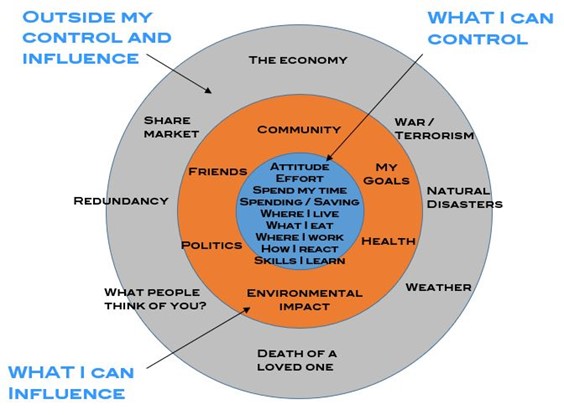
A useful way to stay focused and reduce stress is to separate concerns into three areas:
- Control: Decisions you directly make (e.g., how often you drive, budgeting choices)
- Influence: Areas you can partially affect (e.g., negotiating remote workdays, coordinating shared travel)
- Concern: External forces beyond your control (e.g., global fuel prices, inflation trends)
The goal is to invest most of your energy in the control circle, contribute where you have influence, and avoid over-fixating on what you cannot change.
Three Practical Steps to Respond to higher fuel prices
Step 1: Optimize What You Control
- Plan routes and consolidate trips to reduce fuel usage
- Set a weekly fuel or transport budget
- Consider alternatives like cycling, public transport, or remote work days
Step 2: Strengthen Your Influence
- Coordinate shared travel with colleagues or family
- Discuss flexible work arrangements to reduce commuting
- Compare providers (fuel apps, insurance, utilities) to find savings
Step 3: Build Financial Resilience
- Reassess spending priorities and cut non-essential costs
- Create or top up an emergency buffer
- Track expenses weekly to stay ahead of creeping cost increases
You can’t control fuel prices – however you can control how you adapt. Small, consistent adjustments in behaviour and planning can offset much of the pressure over time. Focus on what moves the needle within your control and let that discipline compound.
Copyright © 2026 Coastline Private Wealth, All rights reserved.
Our mailing address is:
PO Box 2082
Churchlands WA 6018


